

May, June & September
Dubrovnik, Split or Sarajevo
2 to 3 days
Kravice Waterfalls
Mostar is next to Sarajevo (the city guide can be found here) the one of the main highlights of Bosnia and Herzegovina. It is often visited on a day trip from, for example, Dubrovnik. However, it is worth a trip where you stay the night. Not only because of the city itself, but also because staying gives you time to explore the surroundings, and there is more around Mostar worth a day trip than most people realize. Everything about Mostar, where to go, eat and drink, and where to head on a day trip, is in this Mostar and Around travel guide.
Want to know more about the Balkan countries? Check out the full Balkan itinerary here.
May, June and September is the best time, because it is warm enough for the waterfalls and the day trips, without the peak-July/August crowds that pack the Old Town and the bridge. If you want to see the Red Bull Cliff Diving World Series, professional divers competing from Stari Most, not just the usual local jumpers, it’s scheduled for 1 August 2026 (worth double-checking closer to your trip, as event calendars can shift). Expect the town to be considerably busier and accommodation to book up around that date.
Mostar doesn’t have its own major airport, so most visitors fly into Dubrovnik, Split or Sarajevo and continue overland. Mostar has two bus stations: Mostar West serves international routes from Croatia (Dubrovnik, Split), Mostar East serves Sarajevo and inland Bosnia. From Dubrovnik, buses run several times a day and take 3-4 hours along the coast, with a passport check at the Croatia-Bosnia border. From Split, it’s a similar 3-4.5 hour bus ride. From Sarajevo, Mostar is the easier connection: a scenic train follows the Neretva River in about two hours (two departures a day), or take one of the more frequent buses.
Train and bus timetables and prices change per season, so check current departures shortly before your trip rather than relying on a fixed schedule here. 12Go is a solid one-stop option for comparing and booking bus, train and ferry routes across the Balkans. Of course, there is an option to visit Mostar on a day trip from Dubrovnik including the waterfalls and Blagaj, but this wouldn’t be my recommendation.
01
Mostar is known for the Stari Most. The bridge dates back to 1557, was destroyed in 1993 during the war, and was rebuilt stone by stone using the original Ottoman techniques. It reopened in 2004 as a UNESCO World Heritage Site. It’s the famous bridge in the middle of the Old Town and the icon of Mostar, with good viewpoints on and around it. Make sure to visit during the day and during the night, when it gets less busy and the bridge lights up.


02
Local divers have been jumping off Stari Most for generations, and it’s organized as an annual diving club tradition. Beyond the daily jumpers, every year there is a Red Bull event where professional divers compete jumping off Mostar Bridge. The bridge is roughly 22 to 23 meters high and the water is freezing, even in summer. Often, there are locals around to “demonstrate” a jump for the public, sometimes for a small tip. It is allowed to jump yourself, but always be really careful and practice first with someone experienced.
Way too dangerous for me to jump though. Watching the local guys do it is a really cool thing to watch and it is worth waiting around for. But I would never consider doing it myself.


03
The small town is relatively compact and can be completely packed with tourists, especially during the day when all the day-trippers are in town. The Kujundžiluk, the old copper-and-craft bazaar that runs along both sides of the river approaching the bridge, is the commercial heart. There are many small stalls selling handmade copper coffee set and Bosnian souvenirs. It is a fun atmosphere, but the town did not blow me away.
I wasn’t too impressed by the town itself. It’s pretty, and the bazaar is a nice half hour of browsing, but if you’ve already seen a few Ottoman-era old towns in the Balkans, this one doesn’t feel special compared to Sarajevo’s neighbourhood Baščaršija. It’s still worth the walk, just don’t expect to be blown away.


04
For a small entrance fee (roughly €4-8, with the minaret climb usually priced separately from the mosque interior), you can climb the narrow spiral staircase for a panoramic view over the Old Bridge, the Neretva River and Mostar’s rooftops. It’s a short, steep climb of around 90 steps, and it’s the best viepoint in town if you want a photo of the bridge from above rather than from the crowded river.
05
A very impressive place within walking distance from the Old Town. This place makes you realize how intense the war that took place, not even that long ago, really was. The Sniper Tower (former Ljubljanska Bank) is still there, now covered in graffiti paintings from the outside and inside that reflect the war. They turned bullet holes into art.
Note: the Sniper Tower is not an officially sanctioned attraction. It’s abandoned and unsecured and entering is technically trespassing, though it remains a well-known stop. Enter at your own risk, wear proper shoes, and don’t go alone.
Being there felt a bit scary to me, and not in a fun, thrill-seeking way. It’s an empty, unsecured building with broken glass everywhere, and knowing what it was actually used for during the war makes it very intense. Go here if you want to understand the war, not because you want to make a shot for Instagram..


06
Tucked inside the bridge’s own towers is the Old Bridge Museum, which covers Stari Most’s Ottoman-era construction and its 1990s reconstruction in detail, along with panoramic views from the tower itself. In the neighboring Helebija Tower is the War Photo Exhibition, a collection by New Zealand photojournalist Wade Goddard documenting the Bosnian War and specifically the destruction of Mostar in 1993. The two sit close enough together to combine into one stop. The entrance fee is roughly €5-€10 depending on the combination of the exhibits you choose.
07
A short walk east from the bridge along Marsala Tita street, this is the more comprehensive of Mostar’s war museums: three floors of artifacts, photographs and personal belongings documenting the 1992-1995 war and its victims. It’s heavier and more detailed than the War Photo Exhibition near the bridge, plan at least an hour if you want to actually take it in rather than rush through.
The following day trips, can also be combined into a single day trip from Mostar. We loved the combination of the smaller towns, history and the beautiful waterfall. This guides, discusses the different stops in more detail, as they could also be visited seperately. With our guesthouse (Central Located Guest House), we booked a full-day tour with Dario. There are plenty of other tours, also covering all three of the stops above (Blagaj, Počitelj, Kravice), the south of Bosnia and Herzegovina in one go. You can already book a day tour starting €40!
08
Blagaj is a little monastery, a dervish house or tekija, tucked directly under a cliff at the point where the Buna spring, one of the strongest freshwater springs in Europe, emerges from the rock. We actually didn’t go inside, but how it looks from the outside, from the other side of the water, is stunning enough on its own. It’s only a short drive from Mostar.

09
This place used to be a stronghold on the frontier between the Ottoman and Venetian empires. Now, it feels like a small but beautiful town that stood still in time. Located on the side of a hill, you can walk up to the tower and be rewarded with some more amazing views over the Neretva valley.


10
Kravice is a 28-meter-high waterfall spilling into a wide natural amphitheater of pools, incredibly busy in peak season, so the pictures might not fully show what the vibe is like in summer. Personally, I would have loved to see the place a little less crowded. Still, the water is nice, so definitely take a dip. Good to know: there’s a €10 entrance fee in peak season (June-August), roughly €5-7 in shoulder season, collected between 8:00 and 20:00.


11
The area around Mostar, especially near Čitluk, has been producing wine since Roman times, built on two local grape varieties: Žilavka (white) and Blatina (red). A handful of family-run wineries in the region take visitors for tastings, and it makes a good half-day if you want something different and enjoy a relaxed afternoon.
12
Medjugorje is one of the world’s most visited Catholic pilgrimage sites, with millions of visitors a year. Even without a religious interest, it’s a interesting half-day out. It’s about 25km from Mostar.
Part of this guide should of course cover where to eat and drink, so here’s where I recommend you to go for food and drinks in Mostar.
Black Dog Pub is the only decent beer bar in Mostar. Try one of the local craft beers called “Oldbridz”. They don’t sell food, but they were happy to order something in for us from nearby. Later in the evening, if you feel like another drink, Caffe Bar Marshall is worth a stop: louder music, a terrace, and a simple but good spot for a nightcap.
For dinner, Hindin Han is a lovely restaurant that locals would recommend, one of the best-rated in Mostar and always very busy, so go early to avoid peak dinner times if you want a proper Bosnian BBQ-style meal: grilled meats, cevapi, the works. Divan is the pick if you love wine and a cheese-and-meat platter: right on the water, it’s a good spot for a romantic dinner, and they serve full meals too, not just the platters.
If you want a table with a view of the bridge, Terrace Lagero and Restaurant Bella Vista both look directly over Stari Most, and Najstariji Kafic-Cardak is a small, local cafe that sits almost on top of the bridge itself, a good option for a coffee or a drink rather than a full meal. We haven’t eaten at any of these three ourselves, but they consistently come up as the picks for a bridge-view table.
One more thing: if you only try one street-food item in Mostar, make it burek, the flaky, layered pastry filled with cheese or potato, sold hot at bakeries all over the Old Town. It’s the local standard, and cheaper and often better than what’s on a sit-down restaurant menu.


The perfect place to stay, for the perfect price. We had a bedroom with a shared bathroom, though we never actually saw anyone else around to use it. It isn’t right in the middle of the city center, but it’s a short walk in.
From: €30/night

Another great budget option is Lovely Home City Centre, where you can book a 3-person room including a private bathroom for a very decent price. Rooms are very basic though.
From: €75/night
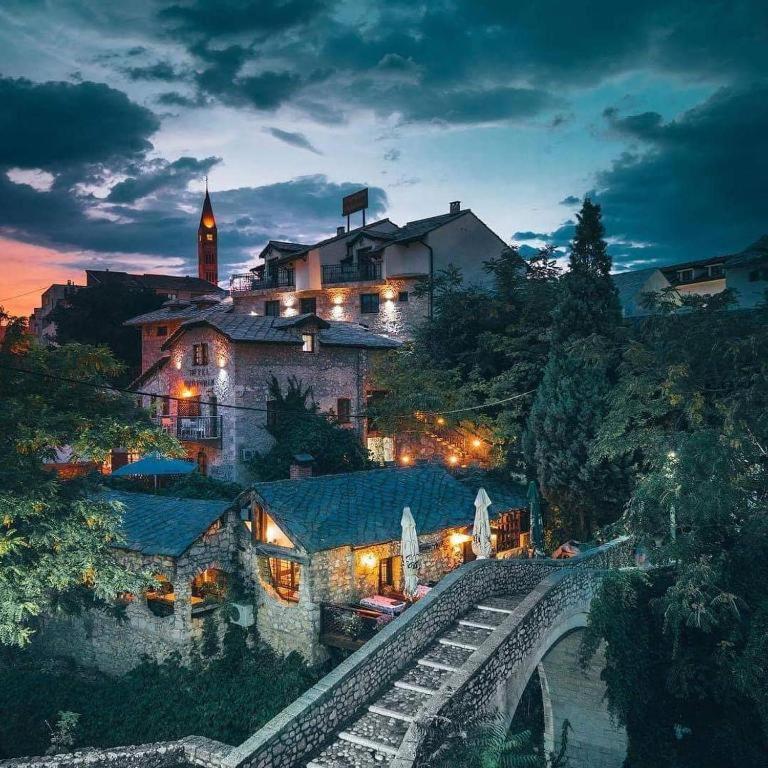
Hotel-Restaurant Kriva Cuprija is a traditional hotel with an amazing exterior very close to the famous bridge. They serve traditional dishes and have a sun terrace overlooking the river.
From: €110/night

A perfect mid-range hotel with a lovely rooftop terrace overlooking the city. The rooms are modern and the views over the city are amazing.
From: €95/night
Before you go
Currency and cards
Currency is the Bosnian Convertible Mark (BAM/KM), though euros are widely accepted for tourist purchases. Cards work in most restaurants and hotels; cash is safer for small vendors and entrance fees like Kravice.
Get an eSIM before you land
Get an eSIM before you land so you have data from the moment you cross the border: get 15% off with code IBT15 at Simify.
Wear proper shoes
The Old Town’s stone streets are polished smooth by foot traffic. Wear shoes with real grip, especially on and around the bridge.
Car Rental
Questions
Stay overnight if you can. The Old Town is at its best early morning and after the day-trip crowds leave in the evening, and staying gives you time for at least one proper day trip without rushing back the same day.
Blagaj, Pocitelj and Kravice Waterfalls together make the classic option, doable as one full day. Medjugorje and a Herzegovina wine tasting are both good half-day alternatives if you want something different from waterfalls and ruins.
It’s an unsecured, officially closed building with no safety rails, so visit at your own risk, in daylight, with proper shoes, and ideally not alone.
Two full days covers it well: one for the town itself (bridge, Old Town, museums, mosque), one for a day trip into the surroundings.
May, June and September for warm weather without peak-season crowds. Early August draws extra crowds around the Red Bull Cliff Diving event.

Save this guide for later
Pin it now, come back when you’re actually planning the trip.
We use cookies to personalize content, provide social media features, and analyze our traffic. We also share information about your use of our site with our analytics partners. You can change your preferences at any time. Privacy Policy Cookie Policy


