

May – mid-Oct
Munich or Salzburg
3 nights
Free buses with the Guest Card
I have to admit, I had never heard of Berchtesgaden before we decided to travel to the south of Germany and explore Bavaria. Berchtesgaden is a small town, right on the border with Austria, and is surrounded by breathtaking nature. It is a perfect base if you want to combine outdoor adventures, a good road trip and potentially a quick dive into Austrian city life. In this Berchtesgaden travel guide, I’ll share everything you need to plan your trip. This is an overview of the best things to do in and around Berchtesgaden, including where to eat and drink and where to stay.
Berchtesgaden is a perfect place to explore the Berchtesgaden Alps, including the famous Königssee. To have sufficient time to explore the area, I would recommend you to stay in town for 3 nights.
Also check out my Garmisch-Partenkirchen travel guide or the full 7-day Bavaria itinerary.
When you buy through links in this blogpost, I may earn a small affiliate commission at no extra cost. Thanks for your support.
Similar to other regions in Bavaria, the best time to visit is late spring to early autumn (between May and mid-October), especially if you want to hike and visit Obersee and Königssee. In winter, the area is popular for skiing, but you get a completely different experience than described in this Berchtesgaden travel guide.
We arrived in Berchtesgaden by car, which is a 2-hour drive from Munich (check your flights to Munich here) or a 30-minute drive from Salzburg. To be able to explore the surroundings, you can book a rental car. Alternatively, you can reach Berchtesgaden Hauptbahnhof by train, however, it will be more difficult to explore the region solely by public transport.
Coming by train from Munich takes around 2.5 to 3 hours, usually with one change in Freilassing. You don’t strictly need a car for a basic visit: once you are staying in Berchtesgaden, the free Guest Card covers most local buses to the Königssee, the Jennerbahn and Ramsau (more on that below). A car mainly gives you flexibility for the Rossfeld Panorama Strasse and for exploring at your own pace. Salzburg is only about 30 minutes away, which makes an easy day trip. Read more about a day trip to Salzburg and whether it is worth it.
To explore Berchtesgaden, I would advise 2 to 3 nights to be able to combine nature and explore the towns. If you want to include a day trip to Salzburg, I would recommend 3 nights to have sufficient time to explore the Berchtesgaden Alps.
01
Let’s start with the most obvious sight in the region and an activity you cannot miss during a trip to Berchtesgaden. The Königssee is a beautiful fjord-like lake, surrounded by alpine forests. You can take an electric boat ride to the St. Bartholomä and walk around or relax in a Biergarten. In peak season (between Easter and mid-October) you can also continue to Salet and hike to the Obersee, which is the lake behind the Königssee and is supposed to be very pretty! A return boat ticket to Salet (the stop for Obersee) costs around €29.80, and a return to St. Bartholomä only costs around €22.50 (2026 costs). You can also visit the Königssee as a day trip from Munich.
Read my complete Königssee travel guide for more information.


02
If you are in for panoramic views without a very intense hike, taking the Jennerbahn cable car is a great activity. The cable car takes you up the mountain, where you can also enjoy amazing views over the Königssee. A return ticket to the top station costs around €47. Alternatively, you can buy the combi-ticket with the Königssee for €56. From here, you can follow the trails towards Carl von Stahl Haus and make a great loop hike. We did this on a sunny day, which probably added to the experience! This was for sure my favorite day of our trip.
Learn more about the different hiking trails around Jenner.


03
The area around Berchtesgaden is beautiful and this is one of the most scenic parts of the entire Alpenstraße. Actually, before I knew we were going to visit Bavaria, I was mainly researching a trip to the Alpenstrasse. After a while, I found that visiting Garmisch-Partenkirchen and Berchtesgaden including the surrounding areas, would make up for a trip that was easier to follow and the Alpenstrasse would be seen on the way anyways. We decided when driving from Garmisch-Partenkirchen to Berchtesgaden, to follow the Alpine Road signs as much as we could, and I would advise you to do the same.
04
In just 30 minutes from Berchtesgaden, you can cross the border into Austria and explore Salzburg. We read great stories about this town, and decided to visit for the day and stroll through the old town. Honestly, we have to say, we weren’t the biggest fan of Salzburg. Nevertheless, if you have time and Salzburg is on your list, visiting the city from Berchtesgaden is just an easy trip.
If you are visiting Salzburg, I would advise a walk to the castle and visit Stiegl Keller on the way for a terrace with great views. Also, at Nur Kaffee, you can get great coffee in an ice cone. Lastly, a visit to the traditional beer hall Augustiner Bräu Mülln cannot be missed and was definitely our favorite activity in town!
Read more about a day trip to Salzburg and whether this is worth it and to book the tours you can't miss out on.


05
Just a short drive from Berchtesgaden, you can find Ramsau which is famous for one key picture: the church next to the river. You won’t need too much time here, but paying a quick visit around sunset, is great, especially if you’re keen on photography.


06
Skip the crowds and drive along the Rossfeld Panoramastraße, one of Germany’s highest scenic roads with panoramic views over the alps. The road loops above Berchtesgaden and offers amazing viewpoints – it is the perfect sunrise or sunset drive. There are several viewpoints along the way to stop and take photos. There is a 9 euro entry fee to access the road. From here, you can also see the Eagle’s Nest. We visited on a very special day, where a comet was out that can only be seen every 80,000 years and the Panorama Strasse was the perfect place to enjoy it!


07
Update: on the evening of October 23, 2026, a fire destroyed a large part of the Eagle’s Nest. Police arrested a suspect for arson. The Bavarian government owns the building and wants to rebuild it, but there is no reopening date yet. Until then, you can’t visit it. The Obersalzberg Documentation Center further down the mountain was not damaged.
While a visit to the Eagle’s Nest is often recommended as one of the things to do in and around Berchtesgaden, we decided to skip this. I’ll explain why.
The history is of course fascinating and the location offers amazing views. However, the Eagle’s Nest is also one of the most touristy attractions in the area. Also, you can’t drive there yourself and therefore escape the crowds, instead, you’ll need to take a special bus. Once at the top, the views are stunning, but they are also often covered in clouds. If you’re into the history, this guided day trip from Munich still goes to the Obersalzberg and the bunkers.
If you’re short on time, I would recommend other experiences and consider skipping the Eagle’s Nest in return for a proper hike, like Jenner or Watzmannhaus, or drive the Rossfeld Panorama Strasse.
Having said all this, once it reopens, and if you are into history and the skies are clear, it could still be worth it, just set your expectations accordingly.
08
The salt mine is one of the most popular things to do in Berchtesgaden, and the obvious plan B for a rainy day. We didn’t go inside ourselves. Salt has been mined here since 1517, and it is still a working mine.
The guided tour takes about 90 minutes. You ride a small mine train into the mountain, go down the wooden miners’ slides and cross an underground salt lake by boat. It is 12°C inside all year, so bring a sweater. Tickets are €26.50 for adults (2026). In July and August it gets very busy, so book a time slot online.
09
This is one we haven’t visited. With the Eagle’s Nest closed, it is the place to learn about the dark history of the mountain above Berchtesgaden. In the 1930s, Hitler made the Obersalzberg his second seat of power. The exhibition shows what happened here and what it led to.
Part of the visit goes through the old bunker system, so wear sturdy shoes. Plan 1.5 to 2 hours. It is open daily from 9am to 5pm (last entry 4pm) and closes for a week of maintenance in November and March. A ticket costs €4.50, or €3.50 with the Guest Card. Bus 838 goes up from Berchtesgaden.
10
Berchtesgaden National Park is the only national park in the German Alps, and the Königssee is part of it. Two easy spots in the park are near Ramsau, so they combine well with a stop at the Ramsau church. We haven’t walked either of them.
The Hintersee is a quiet mountain lake with a flat path along the shore. On the south side is the Zauberwald (“magic forest”), a short trail through mossy boulders and old trees. The Wimbachklamm is a small gorge with wooden walkways along the rock walls. The gorge itself is only about 200 meters long, and entry is €4, paid at the ticket machine at the entrance. It is closed in winter. Bus 846 from Berchtesgaden stops at both (stops Wimbachbrücke and Zauberwald-Hintersee).
Day 1: Visit Salzburg for the day, either on your travel day from Garmisch-Partenkirchen or separately. Make sure to visit the fortress.
Day 2: Visit the Königssee, enjoy the boat ride and visit Obersee. When the evening sets, visit Ramsau and head back to Berchtesgaden.
Day 3: Take the Jennerbahn up and make a great loop hike – afterwards, drive the Rossfeld Panorama Strasse.
Although I liked Garmisch-Partenkirchen better for food and drinks, there are a few excellent options in Berchtesgaden as well.
If you want to explore Bavaria, next to staying in Garmisch-Partenkirchen to visit, for example, the Eibsee and Neuschwanstein, I would highly recommend staying a couple of days in Berchtesgaden to visit the region. The town is small, but it has enough to offer for a couple of days. Alternatively, you can stay outside the town, where accommodations are cheaper. Prices mentioned in this article are based on 2026.
Hotel Schwabenwirt: Located a 50-minute walk from the train station and including a restaurant AND biergarten, this is a great place to stay. The rooms are traditional and simple, starting from €155 a night.

From €120/night (9.6/10)
If you don’t mind staying a bit further and driving a bit to the main sights, then ALPENLIEBE is a great option. This design hotel has modern, but small, rooms for a good price.
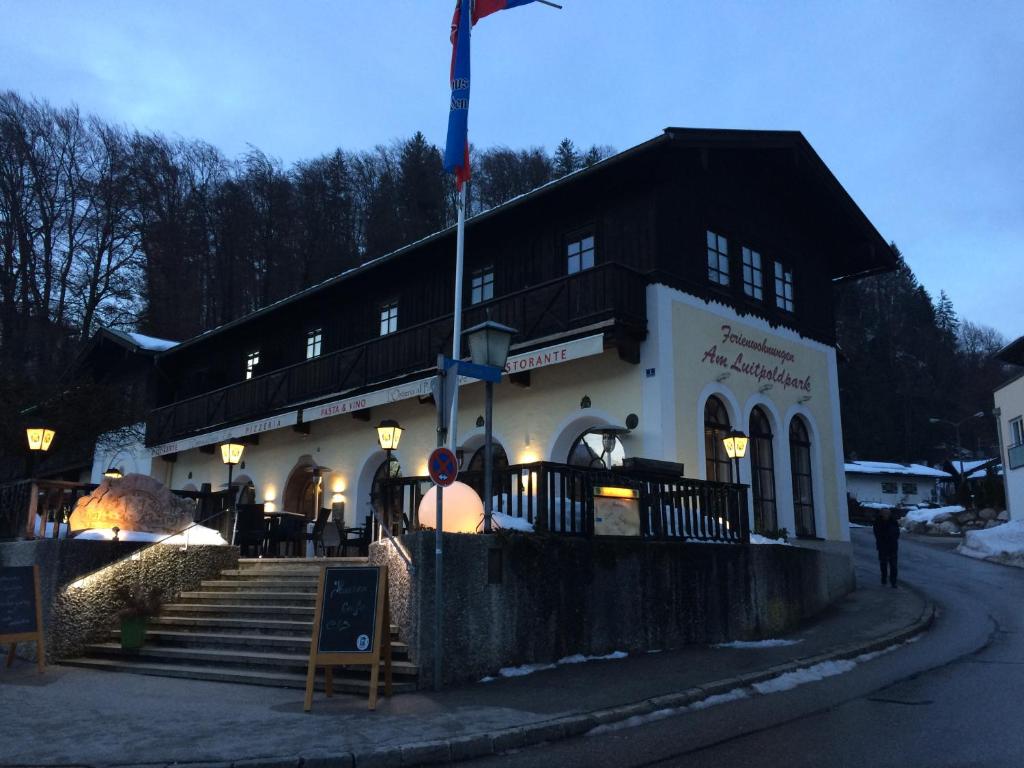
From €200/night (8.6/10)
These large rooms / small apartments are located above a lovely Italian restaurant. The view from the balcony is stunning, and we have enjoyed our morning coffees here. The pictures don’t do the place justice.

From €245/night (9.0/10)
A beautiful hotel centrally located in Berchtesgaden with rooms and balconies overlooking the Bavarian Alps. There is breakfast, a bar, free parking and a swimming pool.
Before you go
Gästekarte (Guest Card)
Every overnight visitor gets a free Guest Card from their accommodation. It covers most local buses, including to the Königssee, the Jennerbahn and Ramsau, plus the train to Salzburg. It doesn’t cover the Eagle’s Nest bus or the Rossfeld toll road.
Eagle's Nest
Closed after a fire in October 2026, with no reopening date yet. In a normal season it opens from mid-May to mid-October, and the only way up is bus 849 (around €32 return, or €29.60 with the Guest Card).
Car rental
There is a bus network, but a car is the easiest way to get around, especially for the Rossfeld Panorama Strasse and the German Alpine Road. You can check rental cars here.
Weather
Mountain weather changes fast. Even in summer, bring a waterproof layer and a warm mid-layer. At the top of the Jenner it can be a lot colder than in town.
Königssee boat
In July and August, the queues at the boat dock can be long, so book your tickets online or arrive early in the morning. The boat to Salet only runs from Easter to mid-October.
Is Berchtesgaden in Germany or Austria?
Germany. It sits in the southeast corner of Bavaria and is almost surrounded by Austria, which is why Salzburg is closer than most German cities. Driving from Garmisch-Partenkirchen, you usually cross Austria, so you need an Austrian vignette.
Get an eSIM for Europe before you leave
Traveling from outside the EU? Mobile data in Bavaria is reliable in cities and major towns but can drop in remote Alpine areas. Buy the Europe eSIM, as you will probably drive through Austria. Use the code IBT15 for 15% off through Simify.
Honestly, probably not soon. We feel like we have seen the highlights, so there isn’t much left on our list here. But it is a really beautiful region, and especially from within Europe, it is underrated. I would definitely go back to Bavaria for more of the area around Munich and Nuremberg. In the meantime, we have already visited Rothenburg, which you can find in our 10 things to do in Bavaria.
Questions
Yes, 100%. We thought it was one of the most beautiful areas in Germany. Even without a visit to the Eagle’s Nest, there is enough to do to fill two to three days.
Three nights gives you two to three full days, enough for the Königssee, the Jenner hike, Ramsau, the Rossfeld Panoramastraße and a day trip to Salzburg. Two nights is too tight for the highlights, unless you stay a night in Salzburg too.
Right now you can’t: a fire destroyed much of the building in October 2026, and it will be rebuilt first. Once it reopens, it depends. The history is interesting and the views are great on a clear day, but you need the mandatory bus, it gets crowded and it is often in the clouds. We skipped it and do not regret it.
Of course, the Königssee is one of the main highlights in Berchtesgaden. However, we also loved the Jenner hike. Take the cable car up, and walk the loop towards the Carl van Stahl Haus. The views over the Königssee are even better than the boat tour itself. The hike is beautiful, but pretty easy.
Yes for the full experience, it is best if you rent a car. It just makes it easier and quicker to get around. Alternatively, you can use the extensive bus netwerk, which is partly free with the Guest Card in Berchtesgaden.


Save this guide for later
Pin it now, come back when you’re actually planning the trip.
Keep planning
We use cookies to personalize content, provide social media features, and analyze our traffic. We also share information about your use of our site with our analytics partners. You can change your preferences at any time. Privacy Policy Cookie Policy


